
Copilotly vs ChatGPT: 131 Expert Copilots vs One Generic Chatbot
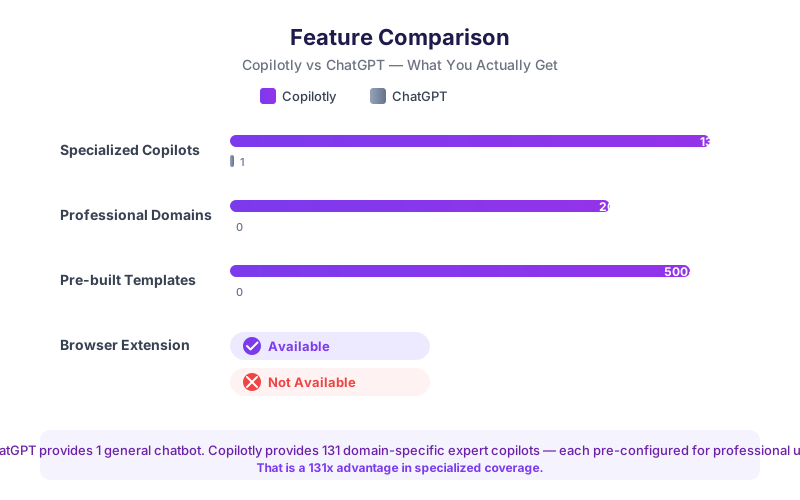
OpenAI is actively restricting professional advice. Copilotly leans in with 131 specialized professional copilots across legal, medical, financial, and 128 more domains.
Quick Comparison
Copilotly
Professional AI copilot platform with specialized assistants
ChatGPT
General-purpose AI chatbot by OpenAI
Copilotly vs ChatGPT: Feature-by-Feature
A structured side-by-side comparison across 12 key dimensions that matter for professional AI usage.
| Feature | Copilotly | ChatGPT |
|---|---|---|
| Specialized Copilots | 131 domain experts | General AI |
| Free Plan | Yes, 3 copilots free | Varies |
| Pro Pricing | From $0/month | From $20/month (Plus) |
| Domain Coverage | 20+ professional fields | Generic |
| Citations & Sources | Authoritative sources | No citations |
| Professional Output Formats | Legal memos, clinical notes, financial plans | Generic prose |
| Pre-built Templates | 500+ professional templates | Limited or none |
| Prompt Engineering Required | None - pre-configured | Extensive |
| Browser Extension | Yes | Limited |
| Mobile App (iOS/Android) | Yes | Varies |
| Multi-Model (GPT-4o, Claude, Gemini) | Yes | Single model |
| Cost per Expert Copilot | $0.22/month | $20/month (Plus) for 1 |
Overview: Why Professionals Are Switching from ChatGPT to Copilotly
ChatGPT changed the world when it launched in late 2022. Within two months it had 100 million users, making it the fastest-growing consumer application in history. Today, ChatGPT remains the most widely recognized AI chatbot on the planet, and for casual use, creative brainstorming, and general Q&A it is genuinely impressive.
But recognition is not the same as specialization. And as millions of professionals discovered, a chatbot designed for everyone is optimized for no one. When a lawyer asks ChatGPT to analyze contract liability, it returns a hedged, surface-level summary that reads like a Wikipedia article. When a physician asks it about differential diagnoses, it appends so many disclaimers that the clinical value evaporates. When a financial advisor asks it to model tax scenarios, it refuses to commit to any specific analysis.
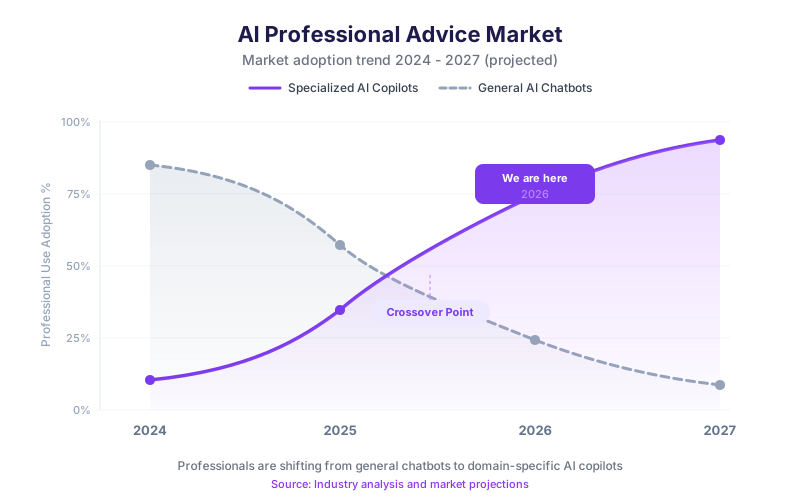
This is not a flaw in the technology. It is a deliberate product decision. OpenAI has been systematically restricting ChatGPT from providing professional advice across legal, medical, financial, and therapeutic domains. Internal policy documents, public statements from OpenAI leadership, and observable behavior changes all point to the same conclusion: ChatGPT is pulling back from professional advice because the liability risk is too high for a consumer product with hundreds of millions of users.
Copilotly was built for exactly the gap ChatGPT is creating. Instead of one general-purpose chatbot that avoids professional specificity, Copilotly offers 131 specialized copilots — each purpose-built for a specific profession with domain-specific knowledge, professional output formats, and transparent disclaimers. The Legal Copilot thinks like a lawyer. The Health Copilot thinks like a clinician. The Finance Copilot thinks like a financial advisor. Each one is pre-configured with the terminology, frameworks, and standards of its profession.
The core insight: As general-purpose AI chatbots retreat from professional advice, specialized AI platforms like Copilotly are leaning in — delivering the domain expertise that professionals actually need, with responsible disclaimers and transparent limitations.
This is not a marginal difference. It is a fundamentally different approach to AI for professional work, and it explains why an accelerating number of lawyers, clinicians, financial advisors, engineers, and other professionals are adding Copilotly to their toolkit alongside — or instead of — ChatGPT.
Feature Comparison
| Feature | Copilotly | ChatGPT |
|---|---|---|
| Specialized Copilots | 131 profession-specific copilots | 1 general chatbot |
| Legal Advice | Structured legal analysis with citations | Actively restricted by OpenAI policy |
| Medical Guidance | Clinical-grade copilot with assessment frameworks | Generic disclaimers, refuses specifics |
| Financial Analysis | Tax, accounting, investment, and insurance copilots | Surface-level only, no actionable guidance |
| Engineering Support | Dedicated engineering and technical copilots | General coding help only |
| Professional Depth | Expert-level domain responses with professional formats | Generic, hedged responses across all domains |
| Pre-Built Workflows | 500+ professional templates and workflows | Blank canvas requiring prompt engineering |
| Output Formats | Legal memos, clinical notes, financial plans, reports | Generic prose and markdown |
| Browser Extension | Full-featured, works across all professional tools | Not available |
| Desktop App | Available | Available |
| Mobile App | iOS & Android | iOS & Android |
| Custom Training | Train on your data and domain context | Custom GPTs (limited customization) |
| Team Collaboration | Built-in team workflows | Team plan available |
| Domain Disclaimers | Transparent, profession-specific disclaimers | Blanket refusals to engage |
| Prompt Engineering Required | Zero — copilots are pre-configured | Extensive prompting needed for quality output |
| Context Persistence | Domain context maintained across sessions | Limited to conversation window |
ChatGPT's Professional Advice Restrictions: What OpenAI Won't Tell You
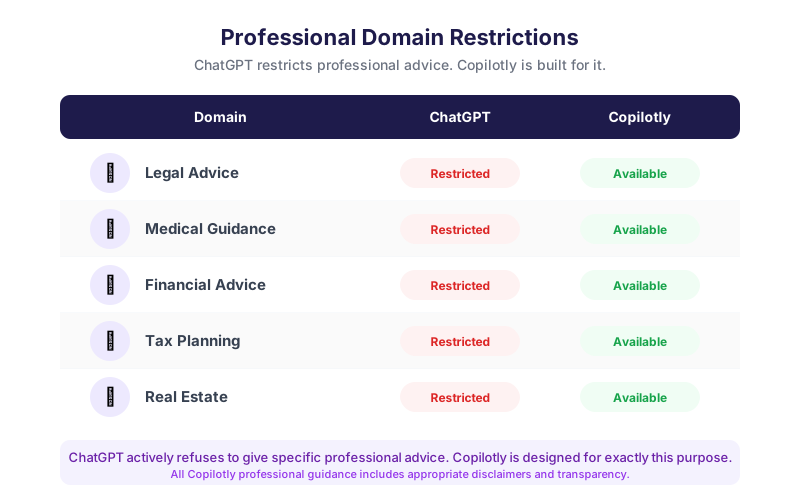
OpenAI's approach to professional advice has shifted dramatically since ChatGPT's launch. What started as an AI assistant willing to engage with complex professional questions has evolved into a system that systematically deflects, hedges, and refuses when professionals ask for domain-specific guidance. Understanding these restrictions is essential for any professional evaluating ChatGPT as a work tool.
Legal Domain Restrictions
Ask ChatGPT to analyze a contract clause for potential liability, and you will typically receive a response that begins with "I'm not a lawyer and can't provide legal advice" followed by a generic overview that avoids any specific analysis. The system is trained to avoid anything that could be construed as the unauthorized practice of law. While understandable from a liability perspective, this makes ChatGPT effectively useless for the millions of legal professionals, paralegals, law students, and business owners who need substantive legal analysis in their daily work.
Copilotly's Legal Copilot takes a different approach. It provides structured legal analysis citing relevant statutes and legal principles, formatted as professional legal memos, with clear disclaimers that it is an AI tool and not a substitute for licensed legal counsel. The distinction is between refusing to help and helping responsibly.
Medical Domain Restrictions
ChatGPT's medical restrictions are even more pronounced. Ask about symptoms, differential diagnoses, treatment options, or drug interactions, and ChatGPT will almost invariably direct you to "consult a healthcare professional" without providing the substantive clinical information that healthcare workers, medical students, and health-conscious individuals need. According to a 2023 study published in Nature Digital Medicine, AI systems can provide clinically valuable information when properly configured — but ChatGPT's blanket restrictions prevent it from doing so.
Copilotly's Health Copilot provides structured clinical assessments, differential diagnosis frameworks, and evidence-based health information with appropriate disclaimers. It serves as a professional-grade clinical reasoning tool, not a replacement for a physician.
Financial Domain Restrictions
Financial advice is another domain where ChatGPT pulls back. Tax planning, investment analysis, insurance evaluation, retirement planning — ChatGPT treats all of these as liability risks and responds with generic information rather than actionable analysis. For the millions of financial professionals, accountants, and individuals making important financial decisions, this is a significant limitation.
Copilotly offers dedicated copilots for finance, tax planning, and investment analysis, each configured with the relevant regulatory frameworks, calculation methodologies, and professional output formats.
Therapeutic and Mental Health Restrictions
Perhaps the most restrictive domain is mental health. ChatGPT will not engage in anything resembling therapeutic conversation, cognitive behavioral techniques, or mental health assessment frameworks. While safety is paramount, this blanket approach ignores the reality that AI-assisted mental health tools have been shown to provide meaningful support when properly designed, as documented by the World Health Organization's guidelines on digital mental health interventions.
The pattern is clear: OpenAI is optimizing ChatGPT for the lowest common denominator of safety — restricting professional engagement across the board rather than building domain-specific safeguards. Copilotly takes the harder but more valuable path: building 131 specialized copilots, each with profession-appropriate guardrails and transparent disclaimers.
Pricing and Value Analysis: The True Cost of Generic vs Specialized AI
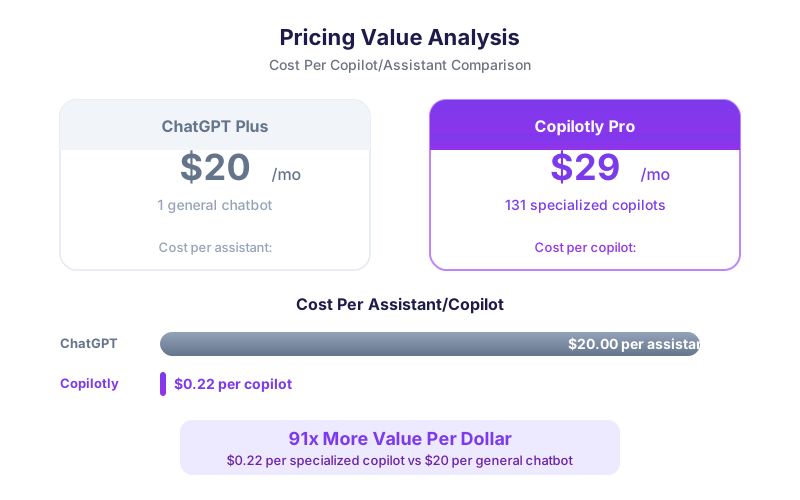
At first glance, ChatGPT appears to be the more affordable option: $20/month for ChatGPT Plus versus $29/month for Copilotly Pro. But a closer look at what each dollar buys reveals a dramatically different value proposition.
ChatGPT Plus: $20/month
- What you get: One general-purpose chatbot with GPT-4o access, DALL-E image generation, web browsing, code interpreter, and file uploads
- What you don't get: Professional domain expertise, pre-configured workflows, domain-specific output formats, or professional-grade guidance in any specialized field
- Hidden cost: Hours spent prompt-engineering to get professional-quality results — often unsuccessfully due to built-in restrictions
- Usage limits: Rate limits on GPT-4o that can interrupt workflow during peak usage
Copilotly Pro: $29/month
- What you get: 131 specialized copilots, each pre-configured for a specific profession, with 500+ professional templates, browser extension, desktop app, and mobile app
- Cost per copilot: $0.22/month per specialized copilot — less than a quarter per expert AI assistant
- Time saved: Zero prompt engineering required; each copilot already knows your domain's context, terminology, and standards
- Professional output: Legal memos, clinical assessments, financial plans, technical specifications — ready-to-use professional formats
The Real Math: Cost Per Professional Use Case
Consider a solo attorney who uses AI for contract review, legal research, and client communication. With ChatGPT, they spend $20/month plus an estimated 5-10 hours per month crafting prompts, reformatting outputs, and working around restrictions. At a billable rate of $250/hour, that is $1,250-$2,500 in lost productivity per month.
With Copilotly's Legal Copilot, the same attorney spends $29/month and gets structured legal analysis, professional memo formatting, and domain-specific guidance without prompt engineering. The time savings alone make Copilotly roughly 40-80x more cost-effective for professional use.
Team and Enterprise Pricing
The value gap widens further at team scale. ChatGPT Team costs $25/user/month for the same general-purpose chatbot. Copilotly Team at $49/user/month provides 131 specialized copilots with built-in collaboration features, shared templates, and team analytics. For a 10-person professional team, the difference is $250/month (ChatGPT) versus $490/month (Copilotly) — but the productivity gains from specialized copilots typically deliver 10-20x ROI. Visit our pricing page for detailed plan comparisons.
Bottom line: ChatGPT is cheaper if you measure by monthly subscription. Copilotly is cheaper if you measure by professional value delivered. For anyone using AI in their professional work, the $9/month difference is the best investment in productivity you can make.
Real-World Use Cases: Domain-by-Domain Comparison
Abstract feature comparisons only tell part of the story. To understand the real difference between Copilotly and ChatGPT, let's examine how each platform handles specific professional scenarios across five critical domains.
Legal: Contract Risk Assessment
Scenario: A startup founder needs to understand the liability implications of a vendor agreement's indemnification clause.
ChatGPT response: "I'm not a lawyer, but generally speaking, indemnification clauses allocate risk between parties. You should consult with a licensed attorney to review this specific clause." Followed by generic definitions and no analysis of the actual clause.
Copilotly Legal Copilot response: A structured analysis covering: (1) what the clause specifically requires, (2) which party bears the greater risk, (3) common negotiation points for similar clauses, (4) red flags to discuss with counsel, and (5) suggested revision language — all formatted as a professional legal memo with appropriate disclaimers.
Healthcare: Clinical Decision Support
Scenario: A nurse practitioner wants to review differential diagnoses for a patient presenting with specific symptoms.
ChatGPT response: "I can't provide medical diagnoses. Please consult a healthcare professional." Some generic information about the symptoms may follow, but no clinical reasoning framework.
Copilotly Health Copilot response: A structured differential diagnosis framework listing probable, possible, and unlikely diagnoses ranked by likelihood, relevant diagnostic tests to consider, evidence-based clinical guidelines, and red flags requiring immediate attention — formatted as a clinical decision support document with clear AI limitations disclosed.
Finance: Tax Optimization Strategy
Scenario: A small business owner wants to understand the tax implications of switching from an LLC to an S-Corp.
ChatGPT response: General information about the differences between LLCs and S-Corps, with a recommendation to "consult a tax professional." No analysis of the specific financial scenario or quantified tax impact.
Copilotly Tax Copilot response: A detailed analysis including estimated self-employment tax savings, reasonable salary requirements, qualification criteria, filing implications, and a step-by-step transition timeline — formatted as a professional tax planning memo with appropriate disclaimers about individual circumstances.
Marketing: Campaign Strategy Development
Scenario: A marketing director needs a comprehensive go-to-market strategy for a B2B SaaS product launch.
ChatGPT response: A reasonable but generic marketing plan outline. ChatGPT performs adequately here because marketing is not a restricted domain. However, the output requires significant customization and lacks industry-specific frameworks.
Copilotly Marketing Copilot response: A structured GTM strategy incorporating B2B SaaS-specific frameworks, channel prioritization based on industry benchmarks, budget allocation models, KPI tracking recommendations, and competitive positioning analysis — using proven marketing methodologies like the RACE framework and Jobs-to-be-Done theory.
Engineering: Architecture Decision Review
Scenario: A software engineering lead needs to evaluate whether to migrate from a monolithic architecture to microservices.
ChatGPT response: A competent general overview of monolith vs microservices trade-offs. ChatGPT is relatively strong in software engineering, though it still requires significant prompt engineering for depth.
Copilotly Engineering Copilot response: A structured Architecture Decision Record (ADR) covering: context analysis, decision drivers, options considered with pros/cons, recommended approach with justification, risk mitigation strategies, migration roadmap, and team capability assessment — formatted as a professional ADR document ready for team review.
The pattern across all five domains is consistent: ChatGPT provides generic information; Copilotly provides professional-grade, structured analysis. For more real-world scenarios, visit our scenarios page to see how Copilotly's copilots handle the professional challenges you face every day.
131 Specialized Copilots vs One Chatbot: The Platform Architecture Advantage
The most fundamental difference between Copilotly and ChatGPT is architectural. ChatGPT is a single AI model behind a single interface, attempting to be all things to all people. Copilotly is a platform of 131 purpose-built copilots, each optimized for a specific professional domain. This is not a marketing distinction — it represents a fundamentally different approach to professional AI.
How Copilotly's Specialization Works
Each Copilotly copilot is pre-configured with four layers of domain specialization:
- Domain Knowledge: Professional terminology, regulatory frameworks, industry standards, and best practices specific to the profession
- Output Formats: Professional document templates — legal memos, clinical assessments, financial plans, technical specifications, marketing briefs — that match how professionals actually work
- Reasoning Frameworks: Domain-specific analytical approaches. A Legal Copilot applies legal reasoning (IRAC: Issue, Rule, Application, Conclusion). A Medical Copilot applies clinical reasoning. A Financial Copilot applies risk-adjusted analysis.
- Responsible Guardrails: Profession-specific disclaimers and limitations that are transparent about what AI can and cannot do in that domain, rather than blanket refusals
The Custom GPTs Comparison
OpenAI introduced Custom GPTs in late 2023 as a way to create specialized versions of ChatGPT. On the surface, this seems like a similar approach to Copilotly's specialized copilots. In practice, the differences are significant:
- Custom GPTs are user-created; Copilotly copilots are professionally engineered. The average Custom GPT is built by a hobbyist in minutes. Each Copilotly copilot is built by domain experts over weeks.
- Custom GPTs inherit ChatGPT's restrictions. A Custom GPT for legal advice still refuses to provide legal analysis because the underlying model's restrictions apply regardless of the GPT wrapper.
- Quality control is absent in the GPT Store. Anyone can publish a Custom GPT with no review of accuracy, safety, or professional quality. Copilotly copilots undergo rigorous testing against professional standards.
- Custom GPTs lack professional output formats. They generate the same general prose as base ChatGPT, just with a different system prompt. Copilotly copilots produce structured professional documents.
Coverage Across 20+ Professional Domains
Copilotly's 131 copilots span more than 20 professional domains, including:
- Legal: Contract review, legal research, compliance analysis, intellectual property, employment law
- Healthcare: Clinical decision support, patient education, medical research, health assessments
- Finance: Financial planning, investment analysis, risk assessment, accounting
- Tax: Tax planning, deduction optimization, entity structuring, filing guidance
- Marketing: Campaign strategy, content marketing, SEO, brand positioning
- Engineering: Architecture review, code analysis, technical specifications, DevOps
- Career: Resume optimization, interview preparation, career planning, salary negotiation
Each domain contains multiple copilots covering different specializations within the field. This is not a single AI trying to cover everything — it is a team of 131 specialists, each excelling in their area of expertise.
Think of it this way: ChatGPT is a general practitioner who knows a little about everything. Copilotly is a medical center with 131 specialists — you see the right expert for your specific need, every time.
Who Should Choose Copilotly Over ChatGPT
Both Copilotly and ChatGPT have their strengths, and the right choice depends on how you use AI in your work. Here is an honest breakdown of who benefits most from each platform.
Choose Copilotly If You Are:
A Legal Professional or Business Owner Dealing with Legal Issues
If you regularly review contracts, analyze legal risks, draft legal documents, or need structured legal guidance, Copilotly's Legal Copilot will save you hours per week compared to trying to extract legal analysis from ChatGPT. Solo practitioners, paralegals, legal operations professionals, and business owners who cannot afford to consult an attorney for every legal question will find immediate value. See how Copilotly serves the legal industry.
A Healthcare Professional or Health-Conscious Individual
Clinicians, nurses, medical students, and health researchers need AI that engages with clinical reasoning, not one that refuses to discuss medical topics substantively. Copilotly's Health Copilot provides structured clinical decision support while maintaining transparent limitations. Learn more about Copilotly for healthcare professionals.
A Financial Professional or Business Decision-Maker
Accountants, financial planners, tax professionals, and business owners making financial decisions need actionable analysis, not generic overviews. Copilotly's Finance and Tax copilots deliver professional-grade financial guidance. Explore Copilotly for the finance industry.
A Professional Who Values Time Over Prompt Engineering
If you have spent hours crafting elaborate prompts to get ChatGPT to produce professional-quality output — and then watched it hedge and refuse anyway — Copilotly eliminates that friction entirely. Every copilot is pre-configured with the right context, frameworks, and output formats for its profession.
A Team Leader Looking for Professional AI at Scale
If you manage a team of professionals who could benefit from AI-assisted workflows, Copilotly's Team and Enterprise plans provide 131 specialized copilots with collaboration features, shared templates, and usage analytics. This is professional AI infrastructure, not individual chatbot access.
Stick with ChatGPT If You Are:
A Casual User who primarily uses AI for general questions, creative writing, brainstorming, and personal tasks where professional depth is not required.
A Developer who primarily needs coding assistance. ChatGPT is competent at code generation and debugging for most programming tasks, though Copilotly's Engineering Copilot provides stronger architectural and system design guidance.
A Student doing general academic research and writing. ChatGPT is adequate for most academic tasks, though professional and graduate students in law, medicine, and business will benefit from Copilotly's specialized copilots.
Budget-Constrained and Needing Only General AI. At $20/month, ChatGPT is $9/month cheaper than Copilotly Pro. If you do not need professional domain expertise and general AI is sufficient for your needs, ChatGPT delivers solid value.
The Bottom Line: Specialists Beat Generalists for Professional Work
The comparison between Copilotly and ChatGPT comes down to a single question: Do you use AI for professional work?
If the answer is yes — if you are a lawyer, clinician, financial advisor, accountant, marketer, engineer, or any other professional who relies on AI for substantive work output — then Copilotly is the clear choice. For $9 more per month than ChatGPT Plus, you get:
- 131 specialized copilots instead of one generic chatbot
- Professional output formats instead of generic prose
- Domain expertise instead of hedged, surface-level responses
- Zero prompt engineering instead of hours spent crafting prompts
- Transparent professional disclaimers instead of blanket refusals
- Browser extension integration that works across all your professional tools
If you use AI casually — for general questions, creative writing, or personal brainstorming — ChatGPT remains a capable and more affordable option. There is no shame in using a general-purpose tool for general-purpose tasks.
But the moment your work requires professional depth — the moment you need a legal analysis rather than a legal overview, a clinical assessment rather than a health disclaimer, a financial plan rather than a finance summary — that is the moment you need a specialist, not a generalist.
131 specialists, $29/month, zero prompt engineering. That is the Copilotly advantage for professionals.
Ready to experience the difference? Start your free trial today and see how 131 specialized copilots transform your professional work. Or visit our pricing page to compare plans, explore our blog for the latest insights on professional AI, and browse the full comparison directory to see how Copilotly stacks up against every major AI platform.
Everything You Need to Know About Copilotly vs ChatGPT
Get instant answers to all your questions about choosing between Copilotly and ChatGPT. Our comprehensive FAQ covers features, pricing, migration, security, and more.
No questions found matching your search.
Still Have Questions?
Our team is here to help you make the right choice. Get personalized guidance on switching from ChatGPT to Copilotly.


Get AI Help Right Where You Browse
Use Copilotly's Compare ChatGPT with Copilotly copilot directly on any webpage. No tab switching.